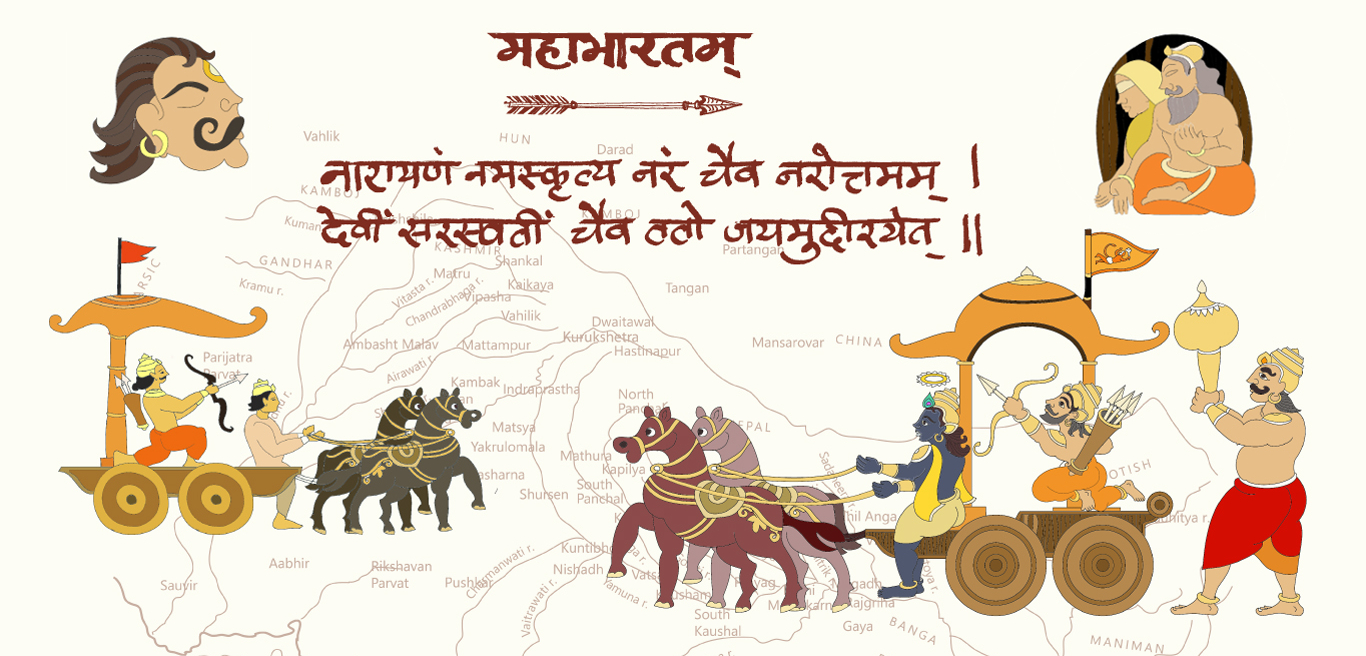
The text here has been taken mainly from the Chitrashala edition. Due to non-availability of good scans of all pages, several mistakes may be present. The original books are available under आकरग्रन्थाः for verification. Please notify mistakes to secretary@sanatanasampatti.in. We will be grateful for your support in making this an error-free text.
To begin with, this portal will host the nīlakaṃṭhīya mahābhārata, i.e., Mahābhārata with the commentary of Nīlakaṃṭha Chaturdhara, called Bhārata-bhāva-dīpa.
As per tradition, Sage Vyāsa composed the complete story of Bhārata and taught it to his four disciples — Vyshampayana, Jaimini, Sumantu and Paila. Later during a Sarpayāga conducted by Janamejaya, Vyshampayana narrated the story of Bhārata to Janamejaya in the presence of Vyāsa mahāmuni.
Ugrashrava described the story of Bhārata to Shaunakadi munis. This narration by Ugrasharava is what has come down to us as Vyāsa Mahābhārata. The other three disciples — Jaimini, Sumantu and Paila — also are supposed to have composed their narrations of Mahābhārata, among which only the Ashwamedhika Parva composed by Jaimini seems to have survived.
In the 17th century, Nīlakaṃṭha Chaturdhara, an eminent scholar, brought out what could be called the first critical edition of Mahābhārata:
बहून्समाहृत्य विभिन्नदेश्यान्कोशान्विनिश्चित्य च पाठमग्र्यम् । after going through manuscripts collected from various places —
Following the path set by Teacher-scholars of the yore, he proceeded to write his commentary Bhārata-bhāva-dīpa — a comprehensive commentary on the Mahābhārata. As its name eloquently suggests, it is a lamp that illumines the inner essence of the epic.