55
Nīlakaṇṭha Caturdhara, the Commentator of the Mahābhārata — His Genealogy and Descendants
By P. K. Gode · Annals of the B. O. R. Institute, Vol. XXIII, pp 141-161
In April 1938 Mr. Sadashive Vishnu Chaudhari, the present Registrar of the Law College, Poona, approached me with a request that I should investigate the tradition current among his family members about their direct descent from Nilakaṇṭha Caturdhara, the celebrated commentator of the Mahābhārata. He further told me that he was unable to link up his known genealogy with that of Nilakaṇṭha Caturdhara as we find it recorded in his works partially. I gladly agreed to investigate the above tradition as I was then preparing a paper1 on the identification of Nārāyaṇatīrtha, the author of the work Bhaṭṭabhāṣāprakāśikā with Nilkaṇṭha’s guru in Mīmāṁsā of the same name. Some information2 given by Mr. Chaudhari about his family together with what I could collect from a study of the works of Nīlakaṇṭha has already been recorded by me incidentally in the above paper, though I could not then record the full evidence in support of my statements based on the information supplied by Mr. Chaudhari. I, therefore, propose to record here the full evidence regarding the genealogy of Nīlakaṇṭha Caturdhara as reconstructed by me on the basis of my study of his works and the information supplied by Mr. Chaudhari.
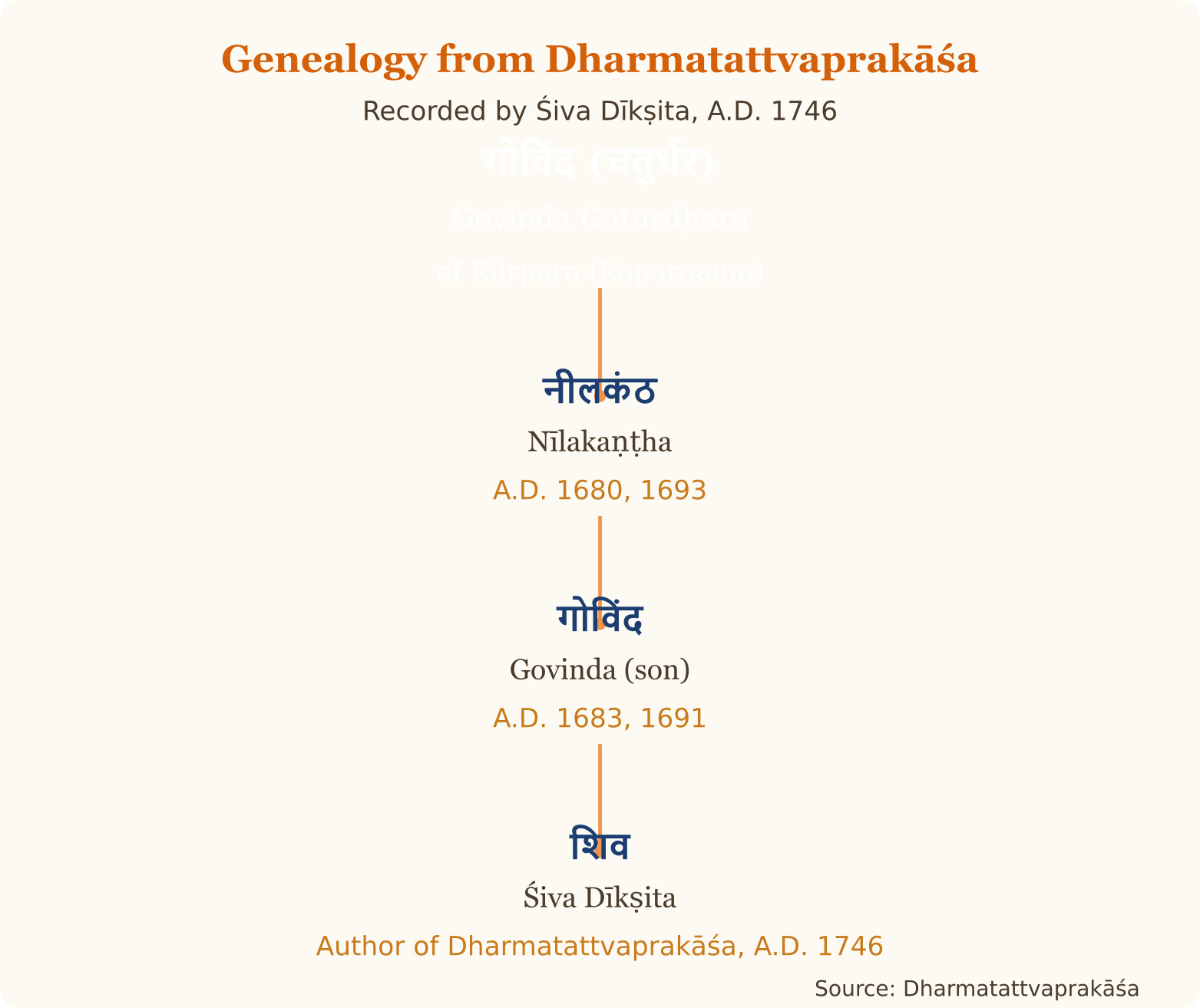
In all the colophons of Nīlakaṇṭha’s works he is called the son of Govinda Sūri.3 We may, therefore, take it that Govinda was the father4 of Nīlakaṇṭha Caturdhara. This parentage of Nīlakaṇṭha is further supported by the following genealogy,5 of the family recorded by Śiva Dīkṣita in his Dharmatattvaprakāśa composed by him at Pratiṣṭhāna or Paithana in A. D. 1746 (Śaka 1668 )6:— गोविंद ( चतुर्धर ) of कूर्परनगरं or Kopargaum on the banks the
नीलकंठ
गोविंद
शिव author of धर्मतत्त्वप्रकाश, composed at Paithana in 1746 A. D. He calls himself by the epithet " वाराणस्यास- जन्मा " or born at Benares.
The gotra of Nīlakanṭha Caturdhara was Gautama7 and his mother's name was फुल्लांबिका. He had three brothers: (1) शिव- (2) व्यम्बक and (3) कृष्ण as pointed out by Holtzmann.8 The above genealogy recorded in A. D. 17469 is further supported by contemporary records10 of the priests at Tryambakesvara near Nasik so far as the names of Siva Dīkṣita and his father Govinda Dīkṣita are concerned. Both the father and the son are described11 in these records as bearing the surname चौधरी and having Shrigonde as their native place but residing at Vārāṇasī or Benares. It appears that नीलकण्ठ, गोविन्द and शिव normally resided at Benares and were educated at this seat of learning, though the family hailed from Kopargaum in the Ahmadnagar district of the Bombay Presidency.
Like Nilakantha an author of the name कमलाकर went to Benares from कुपरग्राम and composed here a work called आचारप्रदीप (B. O. R. I. Ms No. 84 of 1884–86). कमलाकर seems to have been a con-temporary of नीलकंठ and possibly his neighbour at Kopargaum. He quotes Bhattoji Bhatta in the above Ms which is dated A. D. 1729 and refers to gods शुक्रेधर and कचेश at Kopargaum (“प्रामे कूपेर-संज्ञिके.....यत्रास्ति शुक्रेध्ररः । गोदा पश्चिमवाहिनी विजयते देवः कचेशः परः”).”
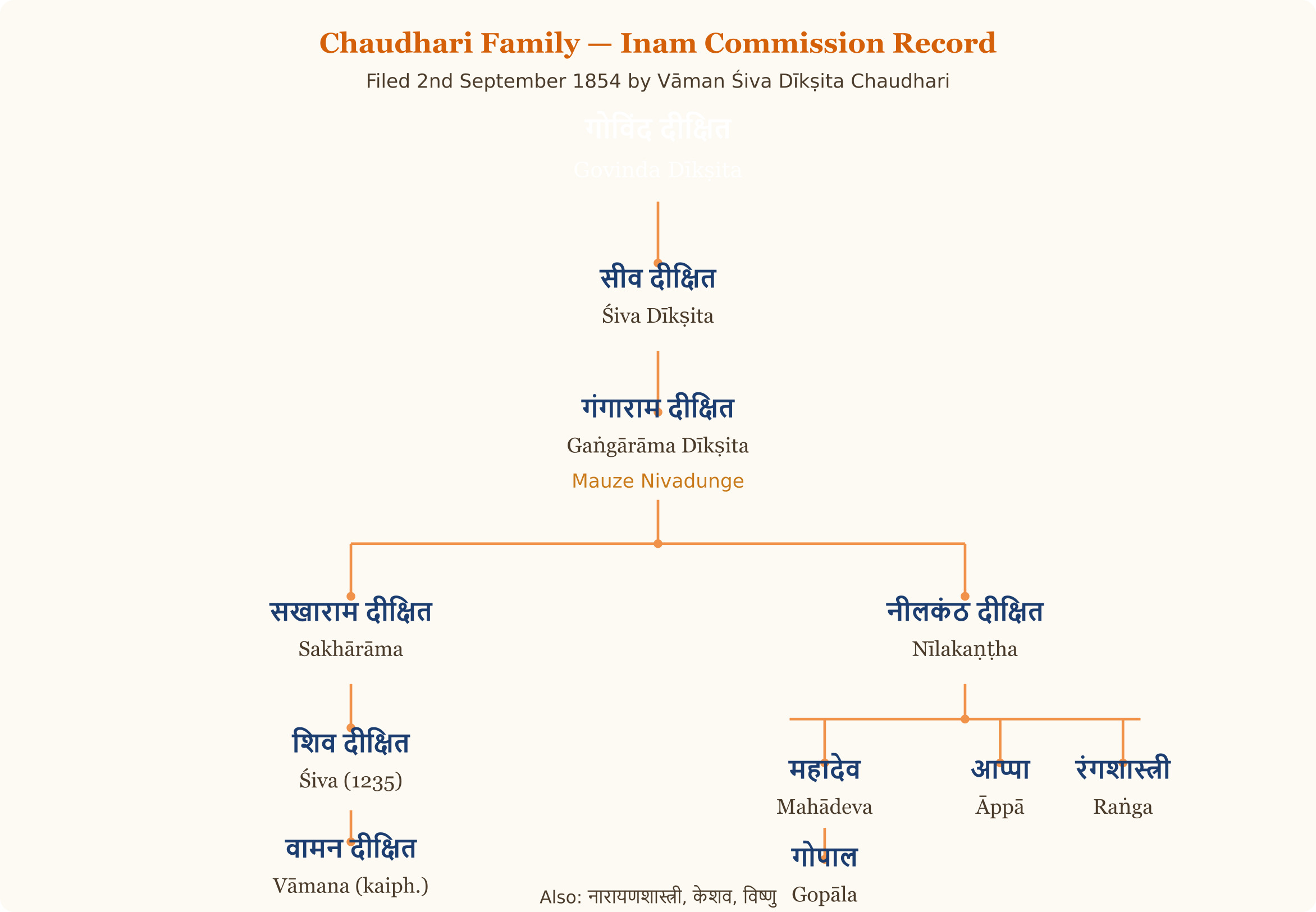
The genealogy of Nilakantha’s family so far reconstructed may now be linked up with the subsequent genealogy of the family as filed on 2nd September 1854 with the Inam Commissioner Poona, by Vaman Shiv Dikshit Chaudhari of the Village Pathardi13 in the Ahmadnagar District. This genealogy is as follows :—
गोविंद दीक्षित
सीव दीक्षित
गंगाराम दीक्षित (मौजे निवदुंगे ता०) शेवगांव येथाल मोकासे अमलाचा मूळसंपादक)
A comparison of the above genealogy with that given by Śiva Dīkṣita in 1746 A. D. shows that the names of गोविंद and his son शिव are common to both these genealogies. The earlier and the later fragment of genealogy being thus riveted at two joints, the accuracy and continuity of the genealogy of the Chaudhari family from Govinda (c. A.³D. 1600), the father of Nīlakaṇṭha Caturdhara, up to A. D. 1854 is now proved beyond challenge.
Three days before the composition of the work Dharmatattvaprakāśa by Śivadīkṣita at Paithana the Maratha King Shahu gave a village as inām to Gaṅgārāma Dīkṣita, the son of Śiva Dīkṣita-on Wednesday, 6th August 174614. The Sanad in respect of this inām is reproduced in the Appendix to this paper from a certified copy of it furnished by the Alienation Record Office, Poona, to Mr. S. V. Chaudhari on 16th December 1927. In this Sanad Gaṅgārāma Dikṣita is described as the son of Śiva Dikṣita, of the surname Chaudhari, gotra Gotam, Sūtra Aśvalāyana, hailing from Benāres, then resident at Paithana. Gaṅgārāma Dikṣita obtained this Sanad through the good offices of Fattesing Bhosale ( A. D. 1707-1760 ) who was regarded by Shahu as his own son.
The names in the genealogy reconstructed and recorded above are supported and supplemented by the Tryambakeśvara Records15 referred to by me already. Mr. V. V. Meghashyam who possesses these records states in his letter to Mr. S. V. Chaudhari dated 30th April 1941 that he has in his possession some writing of Nīlakaṇṭha Dikṣita, son of Gaṅgārāma Dikṣita dated Śaka 1706 = A. D. 1784. This date is consistent with Kiṅg Shahu's Sanad to Gaṅgārāma Dikṣita issued in A. D. 1746.
Hall in his Bibliography16 states that Nilakantha “resided at the village of Kūrpar, now called Koñpar to the west of the river Godāvarī, near the temples of Sukreśvara and Kaceśvara in Mahārāṣṭra”. The above statement occurs in Hall’s description of a Ms of the Vedāntakataka. I have no means of verifying it but presuming that the topography of the residence of Nilakantha at Kopergaum recorded above is based on any references in the Vedāntakataka itself, I have to point out that in the description of Kopergaum in the Bombay Gazetteer17 we find a reference to the temple of Kaceśvara as follows :—
“In the elbow of the Godāvarī and surrounded on three sides by its bed stands a fortified cut-stone enclosure (65’ × 58’ × 60) with massive black walls. It has one gate but the side towards the river is open. In the centre is the cenotaph or thadge, a very small work of timber and brick upon a coarse stone plinth with no writing or ornament. Near the site of the old palace in the island stands the temple of Kaceśvara a set of plain modern buildings held in great honour.” The editor of the Bombay Gazetteer in a footnote on the above passage records “the local story of the Kaceśvara temple” which is the same as the story of Kaca and the Devayānī found in the Purāṇas. This footnote is concluded with the remark : “To this day a stone Shukra and Kach sit side by side on the island and receive much worship.”
If the images of Śukra and Kaca are still worshipped on the island at Kopergaum they must be identical with those in the temples of Kaceśvara and Śukreśvara referred to by Hall in 1859. If Hall’s remarks are based on Nilakantha’s own statement we shall not be wrong in supposing that the residence of Nilakantha at Kopergaum was near these temples situated on the island in the elbow of the Godāvarī. This tentative suggestion regarding the topography of the house of the Chaudhari family at Kopergaum say about A. D. 1750 needs to be verified on the strength of other contemporary evidence.18
We have already referred to the three brothers19 of Nīlakaṇṭha viz. (1) शिव, (2) कृष्ण and (3) त्र्यम्बक. All these brothers were younger than Nīlakaṇṭha. It remains to be investigated if these brothers left any descendants, whose lines could be traced among the present members of the Chaudharī family residing either in the Mahārāṣṭra or outside.20
From the data recorded above the following facts regarding Nīlakaṇṭha’s family and its subsequent history become clear :—
(1) Nīlakaṇṭha mentions his own gotra “Gautama” which is the gotra of Mr. S. V. Chaudharī, the present Registrar of the Law College, Poona. This gotra has been recorded in King Śahu’s grant of A. D. 1746 to Gaṅgārāma, the great grandson of Nīlakaṇṭha.
(2) The genealogy of Nīlakaṇṭha’s family as given by his grandson Śiva Dīkṣita has been linked up with the genealogy filed with the Inam Commission in A. D. 1854 by Mr. Vāmana Śiva Dīkṣita, who is the 6th in descent from Nīlakaṇṭha Caturdhara.
(3) The surname Chaudharī now current in the family was also current in Nīlakaṇṭha’s time as Nīlakaṇṭha in his work com- posed in A. D. 1680 calls himself “ श्रीमच्चौधारे नीलकण्ठ.”
(4) The place of residence of Nīlakaṇṭha’s father Govinda was somewhere near the temples of Śukreśvara and Kaceśvara on the island of the river Godāvarī at Kopergaum. Śiva Dīkṣita, the grandson of Nīlakaṇṭha, refers to these images of कवि (= शुक्र) and कच in his work composed in A. D. 1746. The memory of this resi- dence may have then been fresh in the mind of Nīlakaṇṭha’s grandson.21
(5) From Kopergaum the members of the family of Nīla- kaṇṭha Govinda Chaudharī migrated to Śrigoṇḍe, Pathardī,
Nivadunge and Paithana in the Ahmadnagar district or near its border and settled there. The education of the early descendants of Nīlakaṇṭha upto A. D. 1750 or so appears to have been carried out at Benares. Perhaps the contact with Benares lessened after Shahu’s grant of the village Nivaḍunge to Gaṅgārāma in A. D. 1746.
(6) It remains to be seen if any member of this Chaudhari family composed any important work after the composition of the Dharmatattvaprakāśa by Nīlakaṇṭha’s grandson Śiva Dīkṣita22 in A. D. 1746. Perhaps with a settled life in the Ahmadnagar District the ambition for ach eving eminence in the literary sphere, so characteristic of Nīlakaṇṭha’s life did not stir up the Chaudharis to take to learned pursuits in the manner of their illustrious ancestor.
Post Scriptum
P. S.—After this paper was completed I happened to read a letter23 of A. D. 1683 addressed to one नारायण दीक्षित by हरि दीक्षित from Benares. In this letter one “गोविंद दीक्षित चौधरी” is mentioned as the son-in-law24 of the addressee नारायण दीक्षित. This letter is addressed to नारायण दीक्षित then in Konkan according to Mr. Pimputkar. In the preamble of this the writer informs नारायण दीक्षित the father-in-law of “गोविंद दीक्षित चौधरी” as follows:—
“I took your leave and came to Benares. Thereafter your son- in-law Govinda Dīkṣita Chaudhari wass approached by certain Vaidika Brahman Pandits who bore so ne rivalry to him. They said to him that they would no longer bear any feelings of rivalry to him if he
gives a dinner to 100-200 Brahmans. Then myself and Govinda Dikṣita Chaudhari considered the proposal and brought about the dinner in question. All Mahārāṣṭra Brahmans attended the dinner, Samvat 1740 Śaka 1605, Rudhirodgāri Saṁvatsara, Āśvina Kṛṣṇa Dvitiyā, Guruvāsara."25 After this preamble is recorded a list of Brahmans.
I am inclined to identify गोविंद दीक्षित चौधरी of the above let.er of A. D. 1683 with गोविंद चौधरी the son of नीलकण्ठ चतुर्वेदि who composed one of his works in A. D. 1680. If this identification is accepted it shows that in A. D. 1683 Nilakantha's son Govinda was already a married man, holding some status in Benares society of Mahārāṣṭra and other Brahmans. The letter also reveals for the first time the name of the father-in-law of Nilakantha's son. This man was obviously in Konkan as stated by Mr. Pimputkar and his name was नारायण दीक्षित.”
APPENDIX I
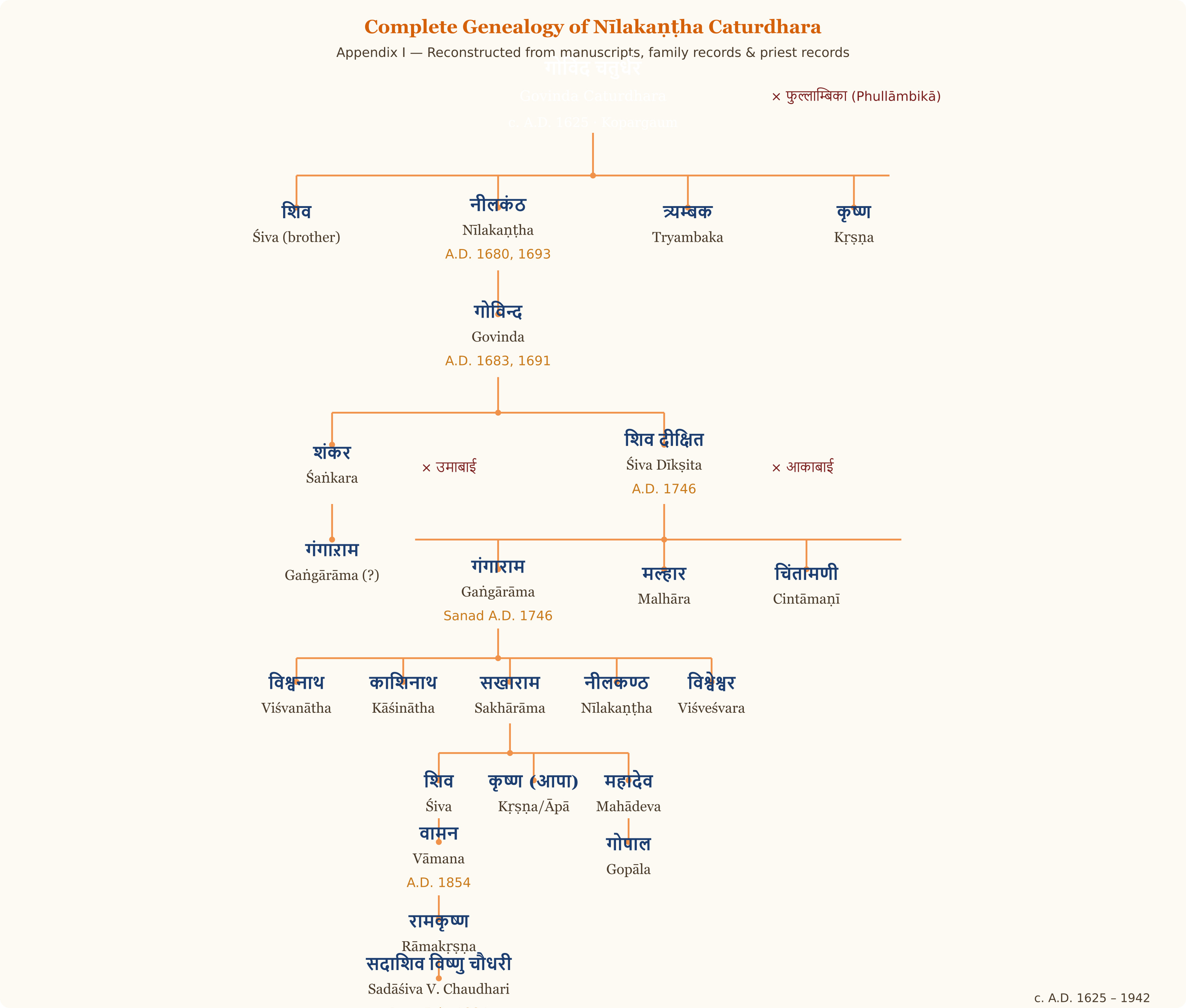
Genealogy of Nilakantha Caturdhara, the commentator of the Mahābhhārata:—
शिव (brother) — गोविंद चतुर्धर (of Kopargaum) × फुल्लाम्बिका (c. A.D. 1625)
I कृष्ण ( A. D. 1680, 1693 ) नीलकंठ शिव त्र्यम्बक I
( × उमाबाई)
गंगाऱाम मल्हार( × रमाबाई) गंगाराम (A.D. 1746) मल्हार चिंतामणी
(?)
I
(A.D. 185+) वामन गोपाल
I
I जिजाबा
old in 1942) I I I I
गोविंदशास्त्री सदाशिव (Born in
February 1884
The above genealogy has been reconstructed by me on the strength of manuscripts of the works of the Nilakantha Caturdhara and other members of his family. It is correct so far as the main line is concerned but needs more evidence for the verification of names in the branch-lines. Some names have been inserted in the above genealogy on the strength of extracts from the records of priests at Trymbakeśvara as they were sent to me by Mr. Sadashiv Vishnu Chaudhari, the present Registrar of the Law College, Poona. It will be seen from the above genealogy that there is unbroken continuity of descent from Govind Caturdhara (c. A. D. 1625) to Sadashiv Vishnu Chaudhari (1942).
APPENDIX II
The sanad from King Sahu to Gangārāma Dīkṣita A. D. 1746
नक्कल
श्री
A COMMISSION |
श्री वर्धिष्णु रविक्रमा विष्णो रामूर्तिरिव वामना शंभूसूनो रसो मुद्रा शिवरा जस्य राजते
स्वस्ति श्रीराज्याभिषेक शके ७३ क्षयनाम संवत्सरे भाद्रपद शुद्ध प्रतिपदा सौम्य- वासर क्षत्रियकुलावतंस श्रीराजाशाहू छत्रपती स्वामी याणी वेदशास्त्र संपन्न राजश्री
राजा शाहू नरपती हर्षनी धान बाळाजी बाळाजीराव प्र धान |
श्रीआई आदिशु रुप श्रीराजा शाहू छ त्रपति स्वामि कृपानिधि तस्य जगजिवन परशु राम प्रतिनिधि |
गंगाराम दीक्षित बीन सीव दीक्षित उपनाम चौधरी गोत्र गौतम सुत्र अश्वलायन कासीकर हल्ली (वा)स्तव्य पैठण यासी दिल्हे ईनामपत्र
एसें तुम्हाविसी चिरंजीव राजश्री फत्तेसिंग भोसले यानी शाहूनगर नजिक किले
सातारा येथील मुकामी स्वामीसंनिध विनंती केली की हे भले सत्पात्र यांचे चालवी- लीया श्रयस्कर ऐसे जाणून यासी आपलेकडून मौजे नीवडुंगे येथील मडीयात्रा कान्दोबा ता तीलगाव पा सेणगाव सरकार आमदानगर हा गाव ईनाम दिल्हा आहे तो महाराजही याचे वंशपरंपरेने ईनाम करून देऊन चालवीला पाहिजे म्हणून विनंती केली त्यावरून मनास आणून तुम्हाही भले सत्पात्र तुमचे चालवीलीया श्रयस्कर ऐसे जाणून स्वामी तुम्हावरी कृपाळू होऊन मौजे मजकूर पेशाजीच्या सुकासीयाकडून करून हाली देखील यात्रामदी कान्दोबाची कुलवाब व कुलकातु हालीपट्टी व पेस्तारपट्टी खेरीज हक्कदार व ईनामदार करून तुम्हास व तुमचे वंशपरंपरेने नूतन ईनाम करून दिल्हा असे तरी तुम्ही मौजे मजकूर सदरहूंप्रमाणे आपले दुमाला करून घेऊन तुम्ही आपले पुत्र- पौत्रादी वंशपरंपरेने ईनाम अनभजून सुखरूप राहणे जाणीजे लेखनकार
मर्या देयं रा जते
रजुसुरू
र्नवी सामंत सुमंत मंत्री सरकार तारीख २९ माहे रजब सु॥ सब अहेन मया अळफ
बारसुद्र सुरू सुद्र बार बार बार बार सदरहुचे असलेलं बंद दोन त्याची चीकटवणी एक ती अक्षराचे एक मोर्तब असे.
नकल करणार आत्माराम रावजी कारकूल ता॥ ४ माहे शपर्टवार सन १८५४ हुा रजु पाहाणार वामन कृष्ण कारकून ता॥ ५ सपटवर सन १८५४ इसवी
Copied by Y. L. THAKAR
Compared by H. R. GURUJI
सदरहु खरी नकल मीळणेबद्दल सदाशिव विष्णु चौधरी यार्णी ता. २०।१०।२७ चे अर्जाने मागणी केल्यावरून खर्चवगैरेबद्दल फी ७९०६ रु. पी. ने मागवून त्यांस देण्यांत आली आहे. ता. १५।१२।२७.
J. R. BARVE अर्धी। कमीशनर मध्यभाग इनचार्ज ॲलिनेशन आफीस रेकार्ड
Genealogy of the Chaudhari family
INAM A COMMISSION
नकल कैफीयतीचे तेरावे जबाबाप्रमाणें
वंशावळ वामन दीक्षीत बीन सीव दीक्षीत चौधरी रा. मौजे पाथर्डी ता॥ सेवगांव जिल्हानगर यांणी मौजे निवडूनगे ता॥ सेवगांव जिल्हानगर येथील मोकासे अमलांबद्दल
अलाहिदा कैफियत लिहून देऊन व्याजबरोबर ही वंशावळ मुळ संपादकाचे आज्ञापासून लिहून दिल्ही असे तारीख २ सप्टेंबर सन १८५४ || मुक्काम पुणे. दस्तुर बापूजी विठ्ठल हुजुर कारकून ता. सरकार सही तारीख १६ सप्टेंबर १८५४ सही वामन बिन सिव दिक्षित दस्तुरखुर्द
Signed before me at Poona on the 16th September 1854 Sd. Thos. A. COWPER Captain Inam Commissioner
Copied by Y. L. SHAHA
Compared by H. R. GURUJI
सदरहू खरी नक्कल मिळणेबद्दल मि. सदाशिव चौधरी याने तारीख २० आक्टोबर सन १९२७ चा अर्ज केलेवरून सदरहू नक्कल ली..... वगैरे फीबद्दल ७५०२ रुही. पी. ने मागवून लास देण्यांत आली आहे. तारीख १६ माहे डिसेंबर सन १९२७. H. R. GURUJI
J. R. BARVE असीस्टंट कमीशनर मध्यभाग इंचार्ज पलीनेशन रेकॉर्ड ऑफीस
गोविंद दीक्षित
सीव दीक्षित
गंगा राम दीक्षित (मौजे निवदुंगे ता।। शेवगांव येथील मोकासे
सखाराम दीक्षित नीलकंठ दीक्षित
रंगाशास्त्री नारायणशास्त्री केशव दीक्षित विष्णु दीक्षित का.